Notting Hill Carnival 2026 · Sunday 30 August
J’ouvert: Before the Road Wakes Up
Before the feathers, before full daylight and before anybody sensible is awake, Carnival opens in paint, powder, iron, pan and beautiful disorder.
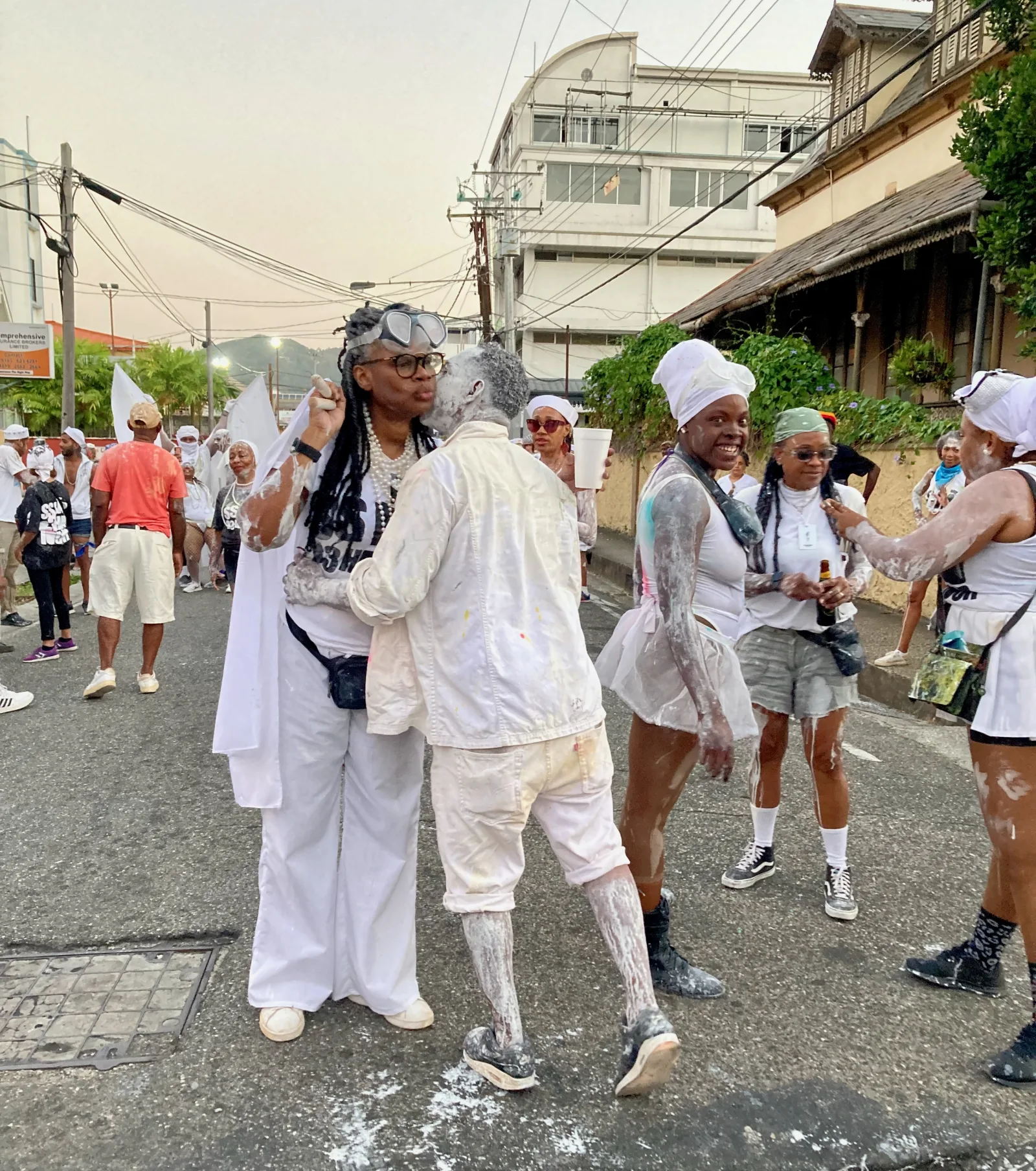
Trini.lise / CC0
Six in the morning is an unreasonable time to be this happy.
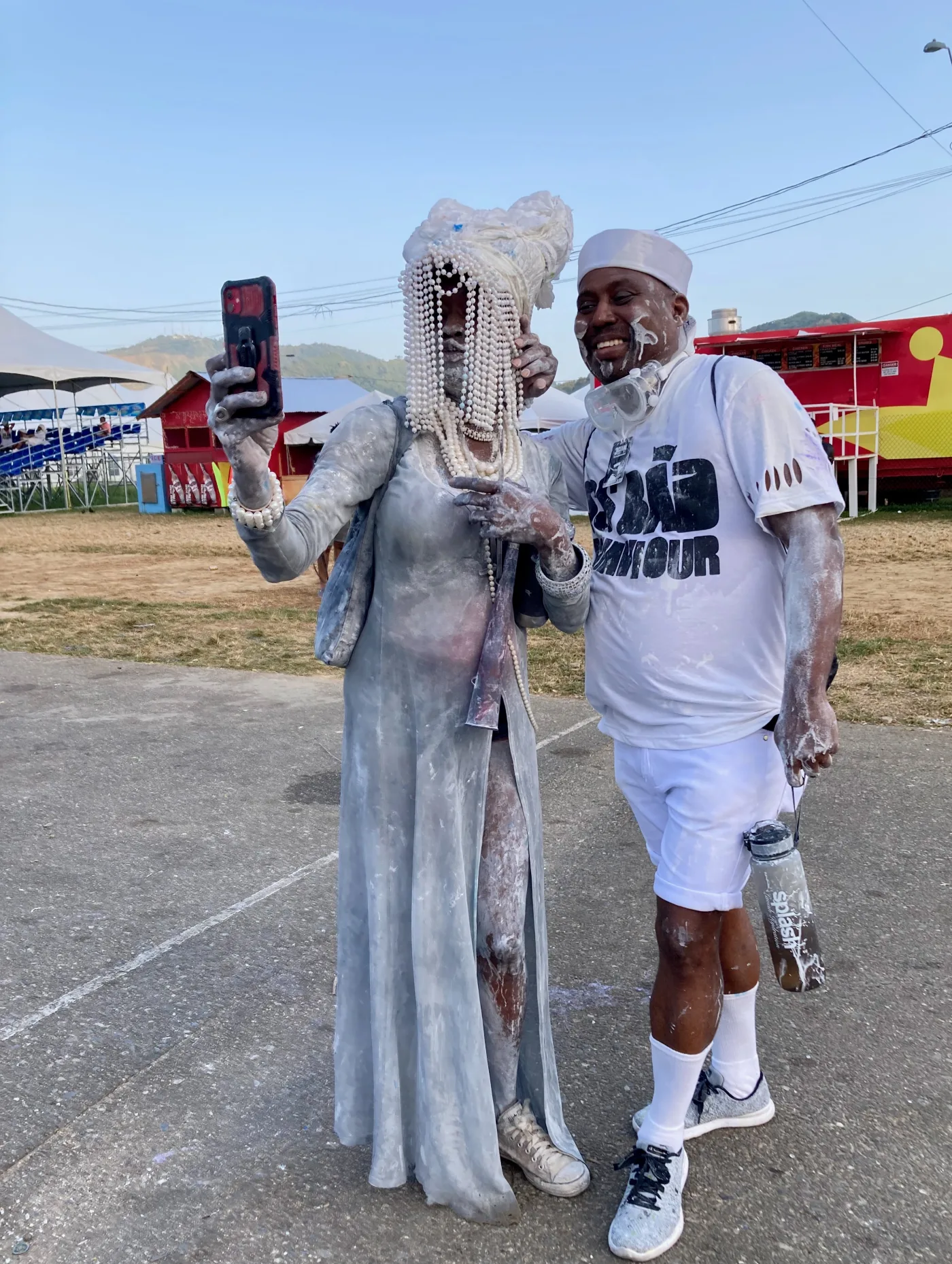
The sky over west London has barely made up its mind. Somebody’s got paint in their eyebrow already. Somebody else has goggles on with the seriousness of a lab technician, except the lab is Canal Way and the experiment appears to be: what happens if we add powder, steelpan and several thousand people who refused to go to bed?
Your trainers are finished. Accept it.
J’ouvert has begun.
The name comes from French Creole: jour ouvert, the opening of the day. In Trinidad, it marks the pre-dawn opening of Carnival Monday. At Notting Hill, it opens Carnival Sunday — darkness turning to daylight while steelbands, percussion and bodies move through streets that will look completely different a few hours later.
For 2026, the official procession begins at 6am on Sunday 30 August at Canal Way Roundabout and runs until 9am. Three hours. That is the practical information. The meaning is older, messier and much harder to wash out.
Not afternoon masquerading with an early start. Dawn is part of the form.
Notting Hill Carnival’s Diamond Jubilee opens before sunrise.
The official 2026 procession starts at Canal Way Roundabout.
By then the light is up and Children’s Day is preparing to take the road.
This is not simply a paint party
Paint is the photograph everybody understands. Bright faces. Ruined T-shirts. A woman laughing because her friend has just emptied half a bottle of something luminous down her back. It looks joyful because it is.
But if that is all we see, we miss why J’ouvert needs the dark.
This is Carnival before polish. Before the big costume has to hold its line at the judging point. Before spectators and performers settle into their daytime positions. J’ouvert makes space for old clothes, mud, oil, powder, devils, placards, satire, anonymity and the pleasure of becoming difficult to recognise.
It carries the memory of people turning what power called unruly into a language of their own.
J’ouvert does not wait for permission to look beautiful. It changes the meaning of beauty.
open.
From Trinidad · carried through the Caribbean
The morning has a memory
Trinidad Carnival emerged through colonial collision: French pre-Lenten masquerade meeting African traditions of masking, rhythm, dance, performance and satire under slavery and after emancipation. Canboulay — from cannes brûlées, burnt cane — grew out of the brutal practice of marching enslaved labourers to burning cane fields to cut the crop before it was lost.
After emancipation, formerly enslaved people remade Canboulay as an expression of freedom: masking, dancing, stick-fighting, drumming and mocking the world that had tried to contain them.
Colonial authorities tried repeatedly to suppress the form. The 1881 Canboulay resistance forced an acknowledgement that masquerade would not simply be policed out of existence. Later restrictions pushed the celebration into the dawn hours; J’ouvert became established there, with tamboo bamboo taking the place of banned African drums.
So the darkness is not an aesthetic filter somebody added for atmosphere. It holds history.
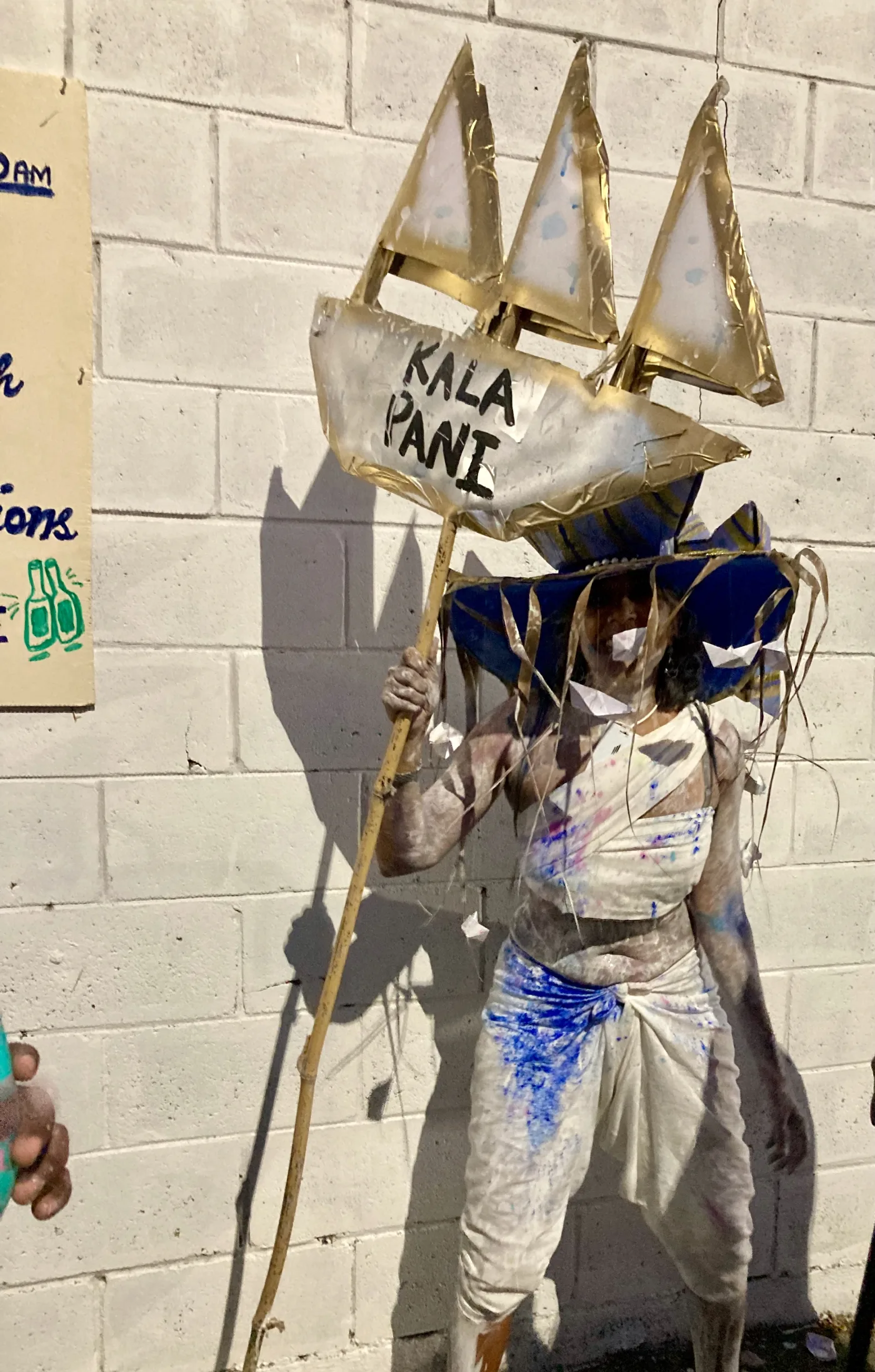
01 · Ole mas talks back
Cheap materials. Expensive meaning.
Ole mas can take cardboard, old fabric, a handwritten sign and one wicked idea, then turn the street into political commentary.
The joke is often the costume. So is the target. Public figures, class pretensions, colonial memory, whatever foolishness dominated the year — all of it can be pulled apart before breakfast.
The Midnight Robber does this with language as much as clothes: giant hat, cape and extravagant Robber Talk. You are not meant to meet modesty at dawn.
Why get dutty?
Because dirt can disguise. Because paint can make a banker and a bus driver equally unrecognisable. Because mud refuses the idea that Carnival must prove its value by looking expensive.
Traditional J’ouvert materials do different jobs. Mud connects the body to earth and to the anti-pretty vocabulary of old mas. Oil and grease transform skin into another surface. Powder travels through the air and marks everybody nearby, including the person who was certain they were “just watching”. Paint turns friendship into an ambush.
None of that means every substance belongs on every road now. Safety, consent and what a band actually permits matter. The tradition is alive; it does not need anybody using literal tar in 2026 to prove they read the history.
What survives is the principle: J’ouvert strips status down, interrupts the everyday body and makes room for another one.
The palette before daylight
These are not decorative finishes laid over the same experience. Each material changes how a masquerader looks, moves, touches and disappears into the band.
Mud
Heavy, tactile and deliberately anti-glamour. The body becomes landscape.
Paint
Colour transferred hand to hand. Nobody stays pristine for long.
Powder
A cloud before sunrise, settling across a whole band instead of one costume.
Grease
Historically central to devil mas, turning recognisable skin into performance.
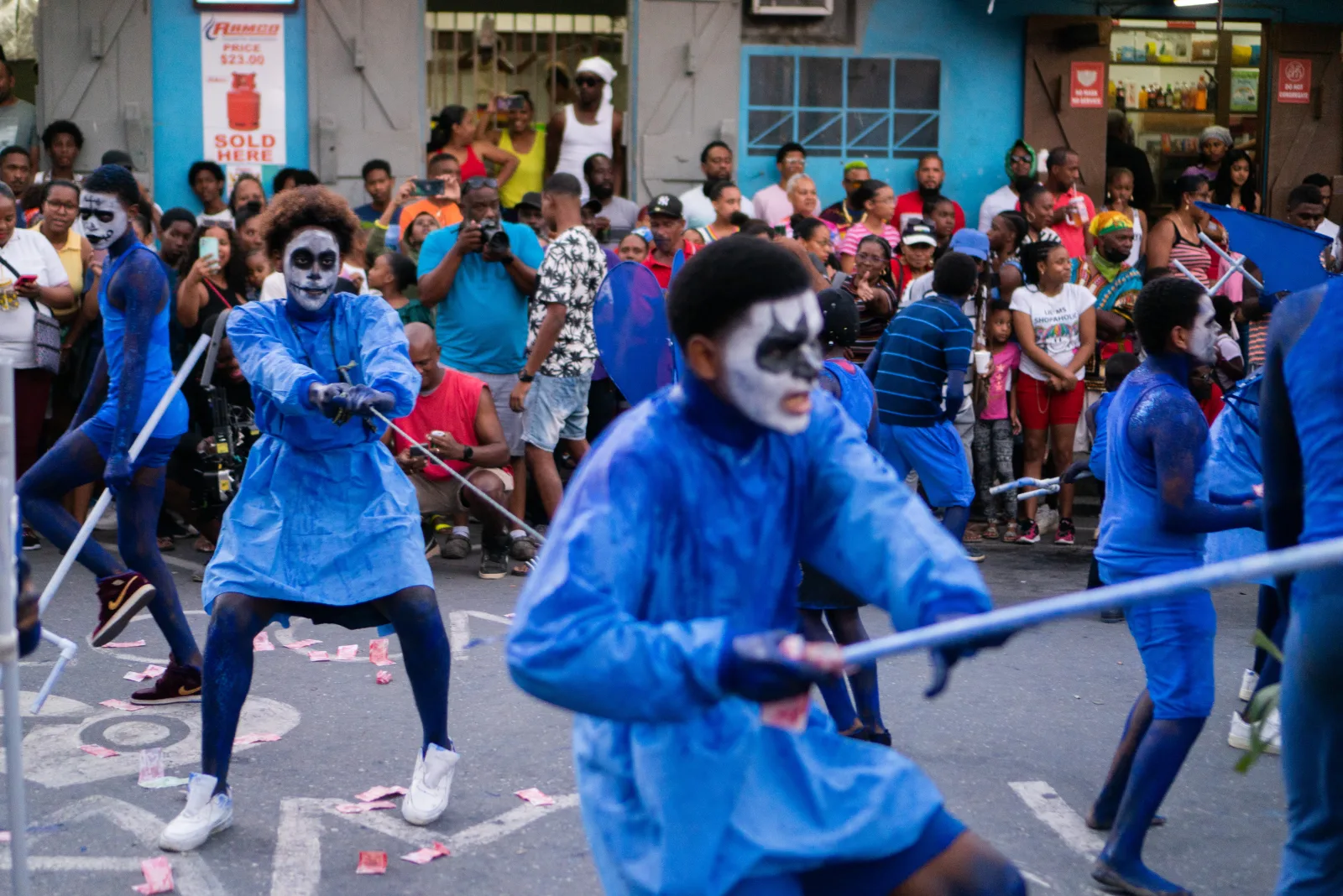
The devil is not there to be well behaved
Jab comes from the French Creole for devil. In Trinidad’s Jab Molassie tradition, horns, chains, pitchforks, grease, mud and coloured dyes build a character apparently held back by imps while the body pulls, wines and threatens escape.
It is theatre made from menace, rhythm and control. The character looks wild; the playing is skilled.
Junior Jab, Paramin, Trinidad, 2023 · Lesley Granderson / Wikimedia Commons · CC BY-SA 4.0You hear the morning before you see it
In J’ouvert, rhythm is not background music added to an activity. Rhythm is how the activity becomes a procession.
In Trinidad’s history, African drums were restricted; tamboo bamboo and later iron carried the beat. Metal beating helped open the path towards steelpan. The engine room — iron, brake drums, congas, scratchers and percussion — gives the music its forward pressure.
At Notting Hill, steelbands remain central to the dawn tradition. That matters in a Carnival whose first moving procession was sparked by Russell Henderson and his players putting pans around their necks and walking through west London.
The sound at six is physical. You do not need a stage. You need something that can move, something people can follow and a rhythm stubborn enough to wake the street.
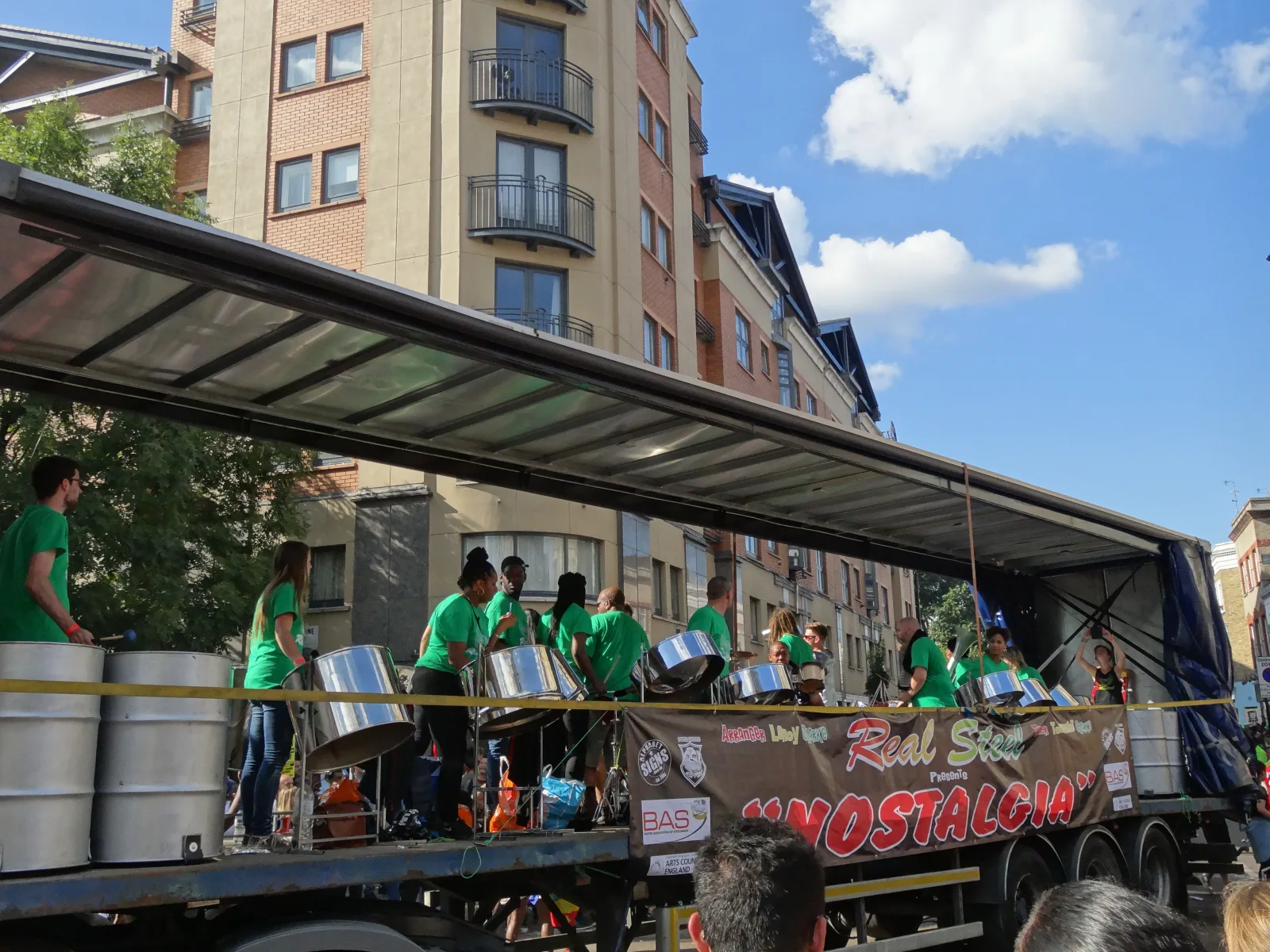
02 · The moving sound
Pan opens the road
Notting Hill has its own translation of J’ouvert, but steelpan joins the London dawn to the instrument that first persuaded the neighbourhood to follow.
By full daylight the weekend will offer sound systems, stages and trucks. At J’ouvert, the older proposition still makes perfect sense: play, walk, answer, repeat.
Real Steel, Notting Hill Carnival, 2016 · Jonathan Cardy / Wikimedia Commons · CC BY-SA 3.0The metallic timekeeper: sharp enough to cut through a moving crowd.
Skin, hand and rhythm carrying call-and-response into the street.
A full musical language made portable, bright and impossible not to follow.
The band answering itself until strangers begin to sound like one thing.
London did not copy J’ouvert. It translated it.
Caribbean traditions do not arrive in Britain vacuum-sealed.
They meet weather, policing, council routes, generations born here, new music and the practical question of what material you can put on thousands of people in residential streets. Notting Hill J’ouvert is shorter and later than Trinidad’s. Its bands and sound carry the specific history of Black British Carnival. Powder and bright paint have become particularly visible parts of the London form.
That does not make it less authentic. Diaspora culture is not a tribute act.
What matters is whether the deep grammar remains: dawn, procession, rhythm, disguise, old mas, release and a public space briefly rearranged by the people inside it.
03 · Devil mas in London
A character crosses the Atlantic
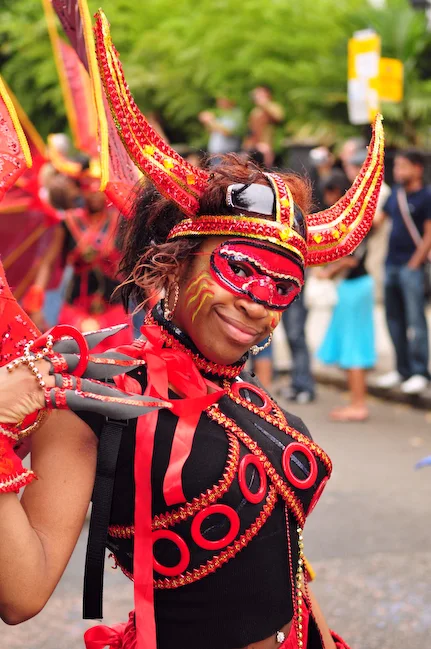
This red-and-black masquerader at Notting Hill carries the visual vocabulary of devil mas into a different city and a different road.
Tradition is not the same costume repeated forever. It is a set of choices recognisable enough to remember where they came from, flexible enough to mean something where they land.
The terms are related, not identical
J’ouvert is the opening. Dutty mas keeps the mess moving.
The daybreak opening procession: darkness moving into light, historically tied to old mas, mud mas, devil mas, pan, iron and the opening of Carnival.
Paint, powder, mud and fun mas continue after J’ouvert has formally ended. Notting Hill’s official schedule lists adult dutty mas through Sunday evening.
Come ready to lose the clean version of yourself
Not your boundaries. Not your common sense. The clean version.
J’ouvert is intimate in a way the big daytime road is not. Paint is touch. Powder travels. A band moves as one crowded body. Consent still matters. So does respecting what the band is doing rather than treating a cultural procession as free props for your content.
Wear clothes and shoes whose future you have already emotionally released. Protect your eyes. Check what substances are actually being used. Do not throw anything at strangers because you saw somebody do it in a video. And if you are standing at the edge determined to remain spotless, J’ouvert may have other plans.
Most of all, listen. The music will tell you when the road is moving.
By nine, daylight has won. The powder is settling. Children’s mas is getting ready. The huge machinery of Carnival is awake.
But J’ouvert got there first.
Day does not simply break. Carnival opens it.