Notting Hill Carnival 2026 · Diamond Jubilee
Mas Bands, Memory & the Art of Playing Mas
A Carnival costume is not just something beautiful to look at. It is a story built by hand, finished by the body and carried down the road.
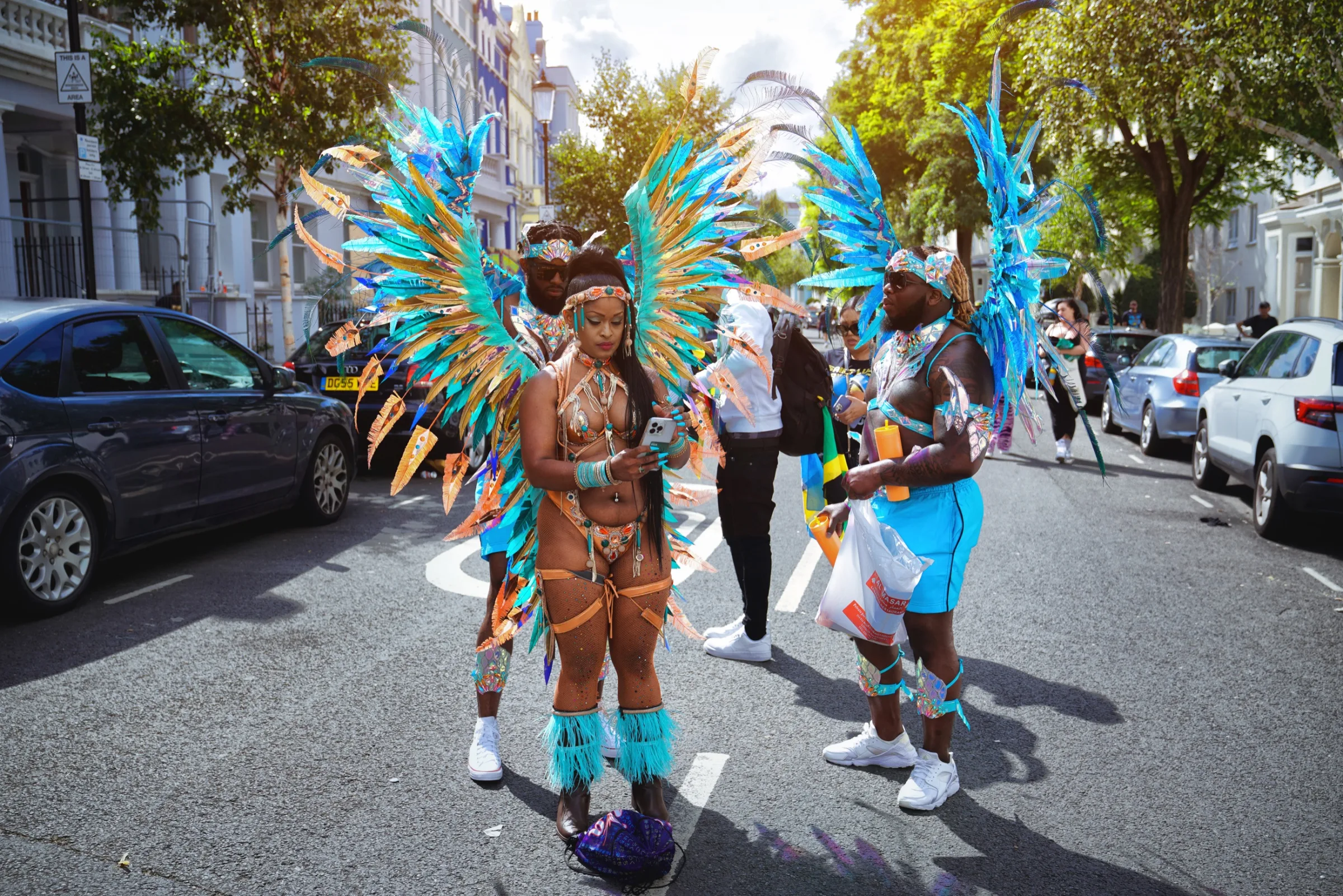
Can Aksoy / CC BY-SA 4.0
A Carnival costume has to survive things fashion was never designed for: hours of dancing, west London weather, a stranger stepping on your feathers, three people asking for a photo while you are plainly trying to eat, and a toilet queue that was not built with a six-foot wingspan in mind.
It still has to look good at the judging point.
That alone should tell you this is not fancy dress.
And this year, the road is carrying extra weight. Notting Hill Carnival marks its Diamond Jubilee in 2026: 60 years since the 1966 street festival that helped set the procession in motion. Six decades later, mas is still doing what living culture does best — remembering, changing and refusing to sit quietly.
At Notting Hill Carnival, the masquerade bands — mas bands, if we are not trying to make a simple thing long — give the road its visual language. Every band chooses a theme. Designers turn that theme into sections, colours, characters and costumes. Makers bend wire, cut foam, stitch fabric, stone bras, glue jewels and persuade feathers to behave. Then the masqueraders put the work on their bodies and make it live.
You do not merely wear mas. You play it.
That word matters. Playing mas asks for more than standing nicely while somebody gets your angles. It is performance: the way you walk, wine, tease, swagger, stalk or spin; the character you step into; the relationship between your body, the music and everybody else on the road.
The official Carnival organisation says each registered band creates a new theme annually, and that the public can buy a costume and join a band to play mas. The bands are judged on Great Western Road across both days. But those practical details only get us to the starting line. The deeper story is about craft, inheritance and the right to take up space — beautifully, loudly and on purpose.
2026
Children’s mas takes centre stage, with adult dutty mas bringing paint, powder and release later on the road.
The adult mas bands come out in full colour, judged as they cross Great Western Road.
The costume is only half the sentence
We are used to looking at Carnival through still images. A photograph freezes the biggest wings, the neatest makeup, the sharpest headpiece. Lovely. But mas was never meant to stay still.
A costume can be laid out on a bed. Mas needs a person.
It needs that little lift when the tune finally drops. It needs the man in a towering collar who has practised how to turn without taking out the whole section. It needs the woman who has been up since stupid o’clock getting ready and still finds another gear when she hears her song. It needs the child who stops waving at Mum long enough to remember the step they learned at mas camp.
The body completes the design. Fringe shows you what it was made for when hips move. Fabric opens in the wind. A headdress changes the wearer’s silhouette; stilts change their height, pace and relationship to the crowd. Even the simplest costume gathers meaning when a whole band moves together.
A costume is what you put on. Mas is what happens when you move.
Inside a mas band
The vocabulary changes slightly from band to band, and modern costume menus can get very specific. These four ideas are enough to understand the shape of what you are seeing.
Short for masquerade: costume, character and performance built around a band’s annual theme.
A part of the band sharing one design or interpretation, then moving together behind the same truck.
Usually the larger, more elaborate version within a section: more structure, feathers and visual impact.
A lighter interpretation of the same section, generally with less scale and more room to move.
Some bands also offer midline, ultra-frontline, individual, bodywear and fun-mas options. The form keeps expanding.
01 · Character enters the road
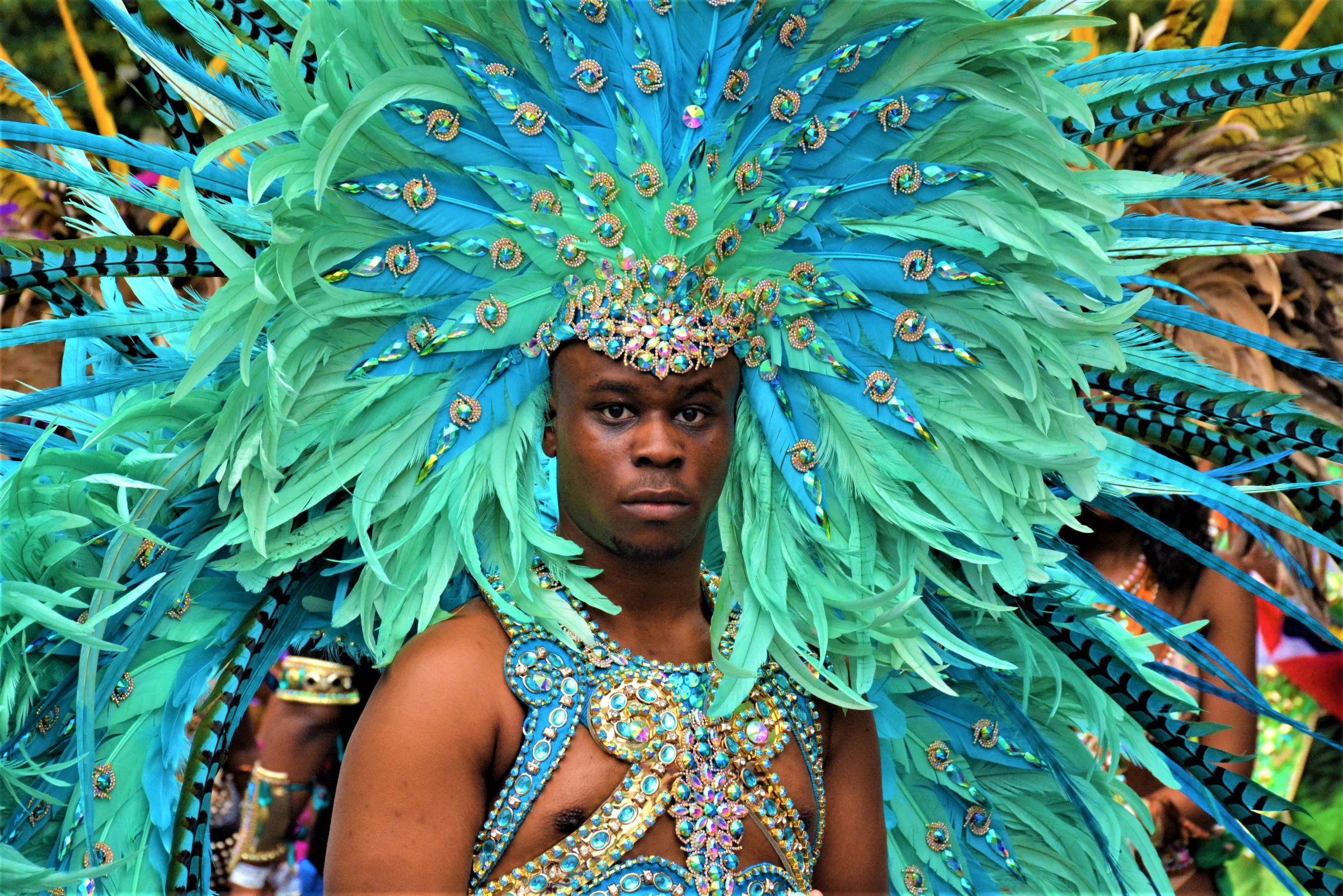
To play is to become
Mas gives permission to become larger, stranger, funnier, more dangerous or more glamorous than an ordinary Monday allows. Sometimes the character is written into the tradition. Sometimes it sits inside a band’s theme. Sometimes it is simply the version of yourself who does not apologise for being seen.
The feathers are doing their job. So is the face inside them.
Before the feathers, there were characters
Mas did not begin as an order form with “frontline” and “backline” options.
Its roots run through Trinidad’s tangled Carnival history: European masquerade, African performance traditions, emancipation, Canboulay, mimicry, resistance and the sly art of making power look ridiculous. Masks hid identity. Speech became theatre. Old clothes became armour. Oil, mud, rope, bells and stilts could transform an ordinary person into something the colonial street could not easily contain.
Traditional mas characters are not quaint pre-history. They carry whole systems of movement, language and social commentary. Trinidad and Tobago’s National Library documents figures including the Midnight Robber, Moko Jumbie, Jab Molassie, Dame Lorraine, Pierrot Grenade and Fancy Sailor. Each comes with its own attitude. You cannot play a Robber apologetically. That cape and hat require a speech.
Five ways to enter another body
This is only a small door into traditional mas. The characters change across islands, generations and individual performers; the point is not to turn them into museum labels, but to notice how much theatre lives inside the form.
Midnight Robber
Huge hat, sweeping cape and language even bigger than both. Robber Talk turns boasting into an event.
Moko Jumbie
A stilt-walking protector with West African roots, seeing farther because the character stands above the crowd.
Jab Molassie
A devil mas marked by grease, paint, chains and menace. “Pretty” was never the only route to power.
Dame Lorraine
Exaggerated dress and body parody the manners and pretensions of the plantation class.
Fancy Sailor
Naval dress remade through spectacular headpieces, precision movement and a family of sailor dances.
Traditional mas · Trinidad
Memory, with a better view
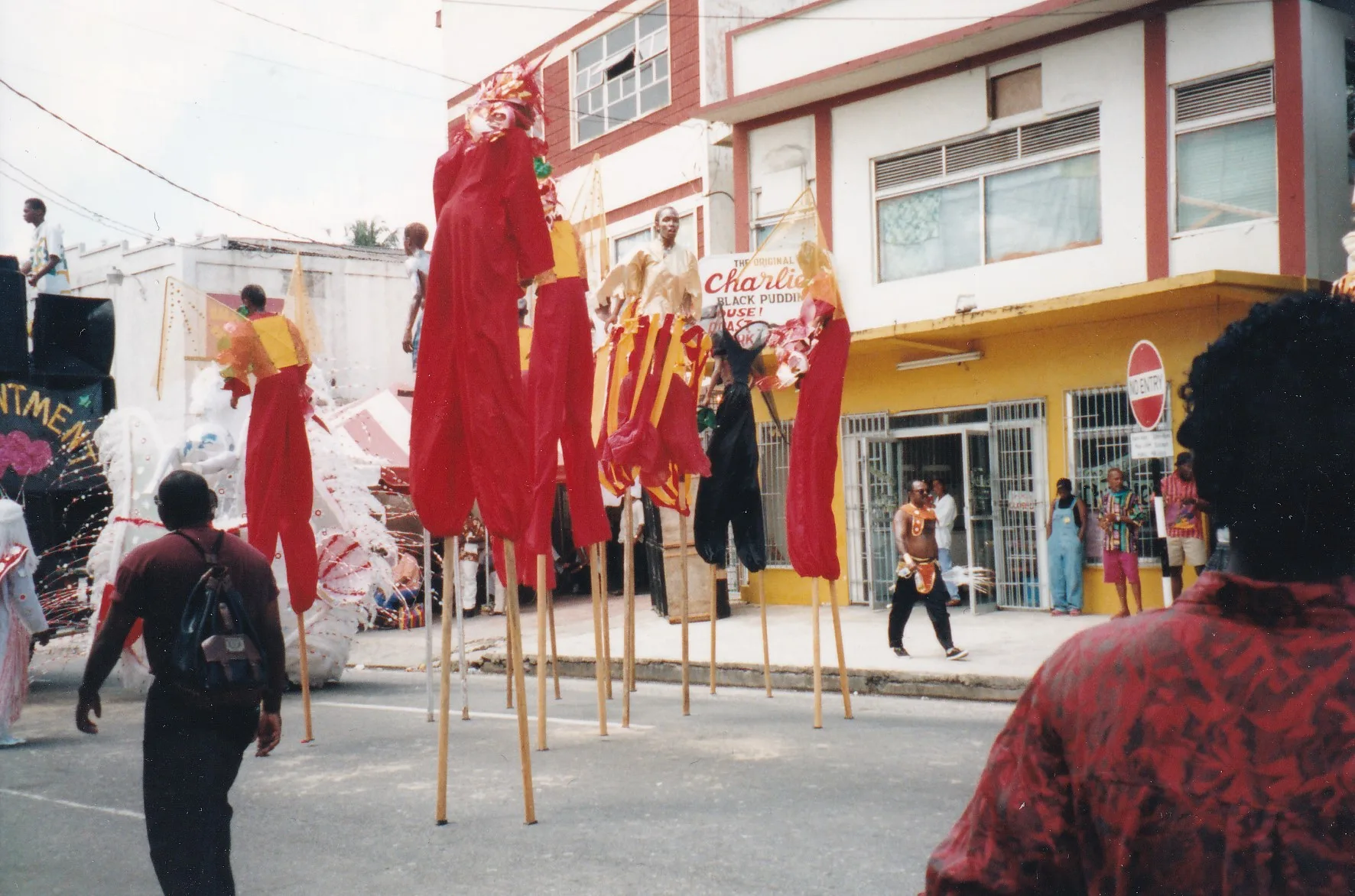
Moko Jumbies do not simply wear height; they play it. The careful stride, the fabric falling from the stilts, the calm above the crowd — all of it belongs to the character.
That is the trick of mas. Material becomes movement. Movement becomes meaning.
Moko Jumbies, Trinidad · Abreauna / Wikimedia Commons · CC BY 4.0The road begins in a workroom
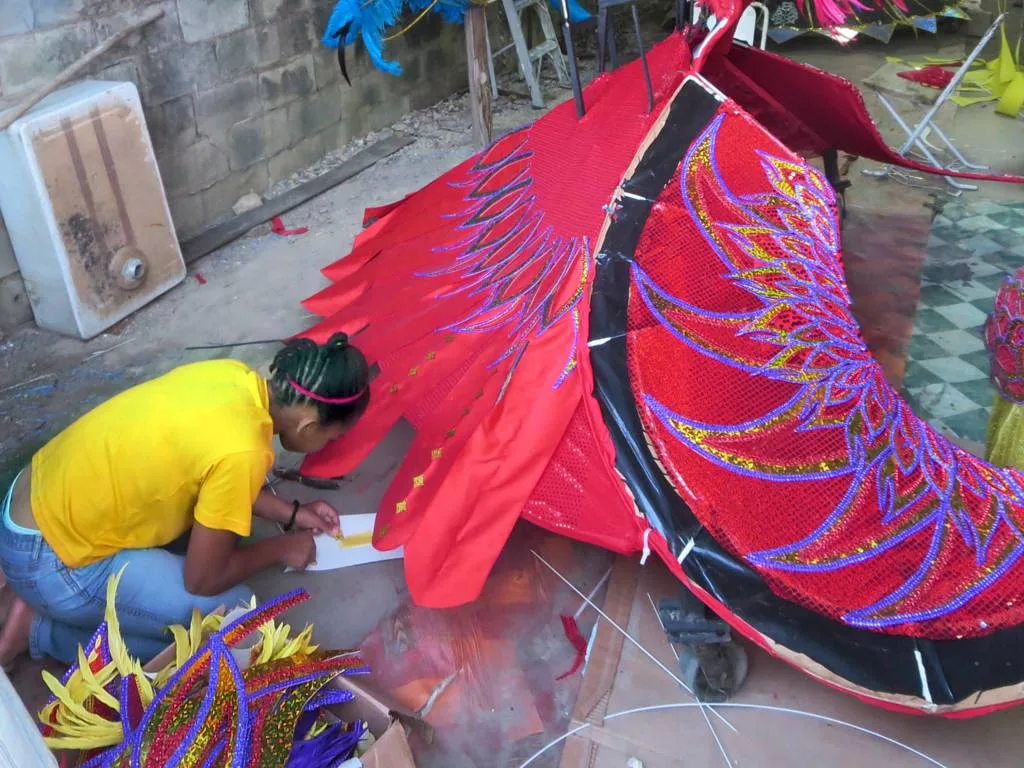
Long before the first truck moves, Carnival sounds like scissors through card, sewing machines, tape tearing, wire scraping the floor and somebody saying, “Hold this for me,” then disappearing for twenty minutes.
This is the mas camp: part studio, part classroom, part community centre, part beautiful last-minute crisis.
Notting Hill Carnival describes mas camps as the places where designers and band members come together to make costumes, but also where people meet, help and hang out. Its own figures are wild when you picture them physically: thousands of feathers and jewels; wire, fibreglass rods, foam and fabric; roughly 15,000 costumes produced each year, usually from June until the August parade.
That work rarely carries the glamour of the final image. It is measuring and remaking. It is glue on fingers and feathers in places feathers have no business being. It is experienced makers knowing which structure will hold and which bright idea will fold at the first corner. It is young people learning that Carnival is something their hands can build, not just somewhere they go.
And, yes, sometimes it is 2am and the hot-glue gun has become a member of the family.
02 · Mas camp
Where spectacle gets its stitches
Every clean line on the road has a messy table behind it. Scale is solved by engineering; beauty is solved by patience; deadlines are solved by whoever is still awake.
The communal making matters as much as the object. A mas camp holds technique, gossip, correction, food, memory and the confidence to try again when the first version is not giving what it promised.
A costume is a small piece of engineering
The right question is not only “Does it look good?” It is “Can somebody dance in it, turn in it, carry it for hours and still feel like themselves?”
Wire and fibreglass rods give shape without asking the masquerader to carry a garden shed.
Fabric, card and foam turn structure into colour, volume, pattern and character.
Stones, jewels, mirrors and metallic finishes catch a grey London sky and send something back.
Feathers, fringe and loose panels reveal the body’s rhythm. A fitting has to test movement, not just measurements.
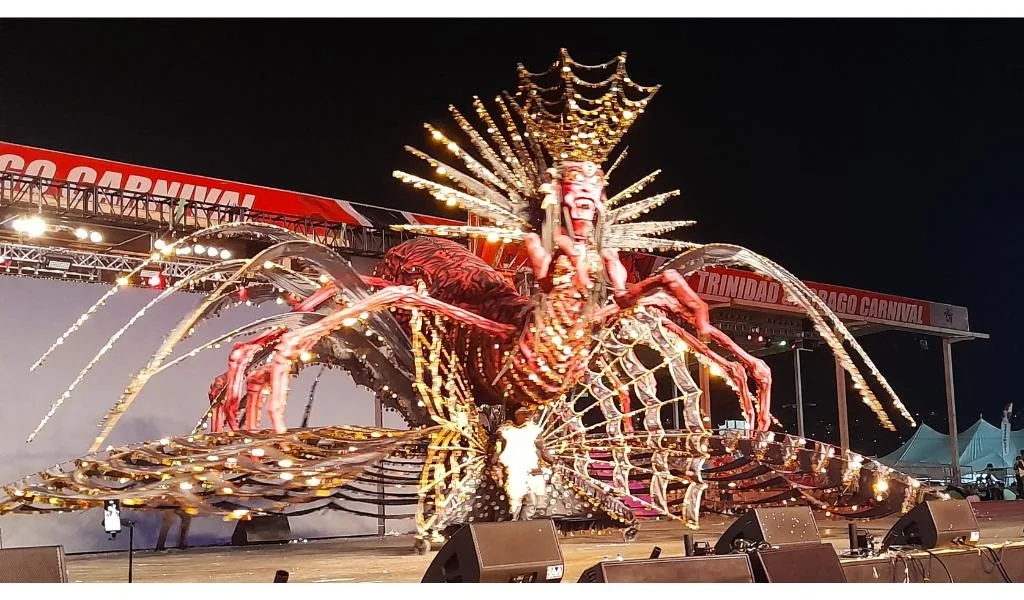
03 · Mas as sculpture
Big mas has to breathe
At the spectacular end of the form, King and Queen costumes turn a single performer into moving architecture. The masquerader is pilot, dancer and load-bearing centre.
Look at the scale, then look again for the person underneath. That relationship is the work: a structure large enough to alter the space, controlled by one body with enough finesse to make it seem alive.
The frame may be clever. The performance is what makes it creature, spirit, story.
Yes, the beads and feathers count
Any proper conversation about contemporary mas has to make room for “pretty mas”: the feathered backpacks, jewelled bodywear, leg pieces, headpieces and sections designed to flood the road with colour and skin.
There is a lazy way to discuss it. On one side, people reduce the whole tradition to an Instagram-ready bikini. On the other, people declare traditional mas the only serious form, as though joy, glamour and women feeling powerful in their bodies cannot carry culture too.
Both positions miss the road in front of them.
Pretty mas is not all mas, but it is still mas. It asks for design, skilled handwork, band identity and performance. For many women, the freedom is precisely the point: a body that is usually watched and judged becomes self-authored, decorated and unapologetically visible. That does not need an academic excuse to be meaningful.
What we lose is not solved by policing what women wear. We lose when the wider vocabulary disappears — when nobody teaches the Robber speech, bends the wire, climbs the stilts, makes the mud, builds the character or understands why satire belongs beside beauty.
Carnival has room. It has always been good at excess.
Bodywear, feathers, jewels and coordinated sections — glamour designed to move together on the road.
Character, speech, satire, disguise, mud, ritual and inherited movement. Not the opposite of modernity; part of its memory.
Notting Hill turns pan-Caribbean
The memory did not arrive neatly packed
Notting Hill Carnival’s beginnings are often compressed until everybody fits into one tidy paragraph. Real culture is less cooperative.
The London Museum identifies 1973, under organiser Leslie Palmer, as a turning point. Carnival became more deliberately pan-Caribbean, drawing in performers connected to Dominica, Grenada and St Lucia. More masks and costumes appeared, including work made by experienced Trinidadian masquerade-makers.
That matters because London mas is not a carbon copy of Trinidad. It is a diaspora form: Trinidadian foundations meeting other Caribbean islands, Black British life, local youth work, new materials, new music and the particular theatre of west London streets.
Memory here is not preservation under glass. It changes hands.
The bands are the infrastructure
A masquerader gets the photograph. A band makes the photograph possible.
Bands develop themes, design sections, source materials, run fittings, organise music and road logistics, teach children, manage people who have ignored every email, and somehow turn hundreds of individual preparations into one moving statement.
For 2026, the official list stretches across dozens of adult and children’s bands, including Arawak, Burrokeets, Ebony Mas, Mahogany Carnival Club, Mangrove Mas Band, Mas Africa, Soca Massive Fancy Sailors UK, Tropical Isles, Utopia Mas UK and many more. Each brings its own history, aesthetic and community. There is no single “Carnival costume” any more than there is one Carnival sound.
If you want to play mas, choose a band because its theme, music and energy feel like somewhere you want to spend the road. Read what the costume package includes. Attend the fitting. Listen when they tell you what shoes to wear. And understand that joining a band means joining somebody else’s months of work — arrive with respect.
Arawak ◆ Ebony Mas ◆ Mahogany ◆ Mangrove ◆ Mas Africa ◆ Tropical Isles ◆ Utopia Mas UK ◆ Vibrance Mas ◆
Children’s Day is not the cute warm-up.
It is transmission.
On Sunday 30 August 2026, children’s mas takes centre stage. Adult dutty mas is also on the road that day; the full adult parade follows on Monday. Watch the children properly and you can see the whole future of the form: a child learning to stay in section, carry a piece, find the rhythm, embody a theme and understand that Carnival is theirs to make.
The knowledge does not survive because adults keep saying “heritage”. It survives because somebody hands a young person a tool, teaches a step, fixes a headpiece, explains the character and lets them feel the crowd answer back.
Look beyond the backpack
The next time a mas band comes down the road, look for the choices.
Look at how the colour travels from one section to the next. Look at the different jobs being done by wire, foam, fabric and feather. Look for who is holding the character and who has briefly abandoned character because their friend has chips. Both are Carnival.
Listen to the music, obviously. This is PLUGGD; we are not asking you to stand there in silence analysing bead placement. But notice what the tune does to the costume. Notice how a whole design changes when the band catches the same rhythm.
That is the art of playing mas: memory does not simply travel in the object. It travels in what the body knows to do.
The costume is not the mas. The person inside it, moving memory through the street, is.