Notting Hill Carnival 2026
The Sound Systems Are the Headliners
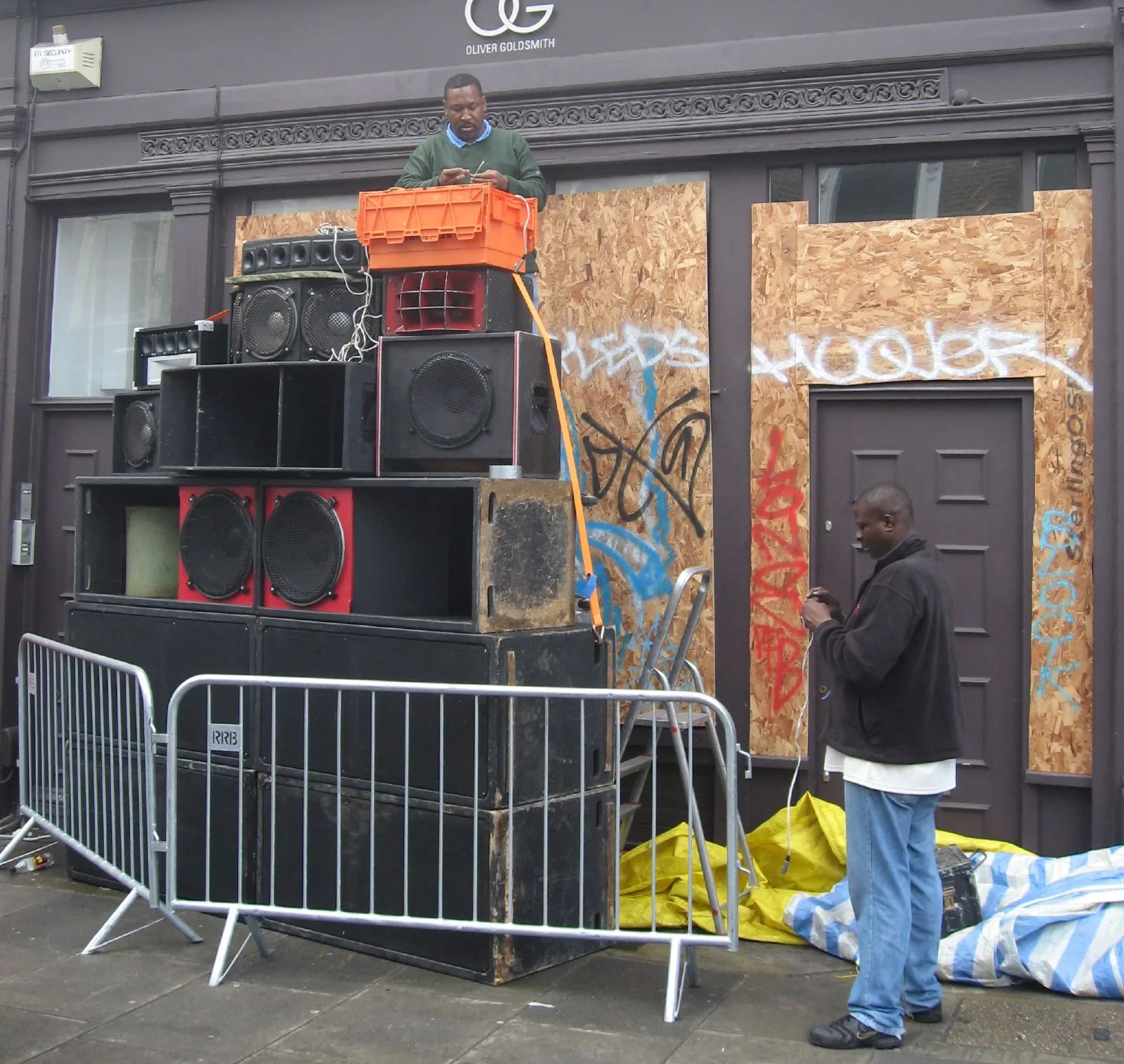
You can keep your main stage. Carnival’s real stars have been sitting on street corners for decades, stacked high enough to block a shopfront and loud enough to rearrange your organs.
There’s a point at Carnival when you stop hearing the bass and start feeling it. Usually somewhere around your ribs.
Your drink is vibrating. Somebody is shouting directly into your ear and you still haven’t got a clue what they said. Your friend, who was next to you approximately 40 seconds ago, has vanished into a crowd that appears to have doubled while your back was turned.
And the bassline keeps rolling.
If you know, you know.
Every August, the group chat fills with the same rumours. Who might turn up. Which artist has been seen near which barrier. Whose cousin’s boyfriend definitely knows somebody. Fine. London enjoys a surprise guest as much as anybody. But the thing holding that corner is not a famous face. It is the sound.
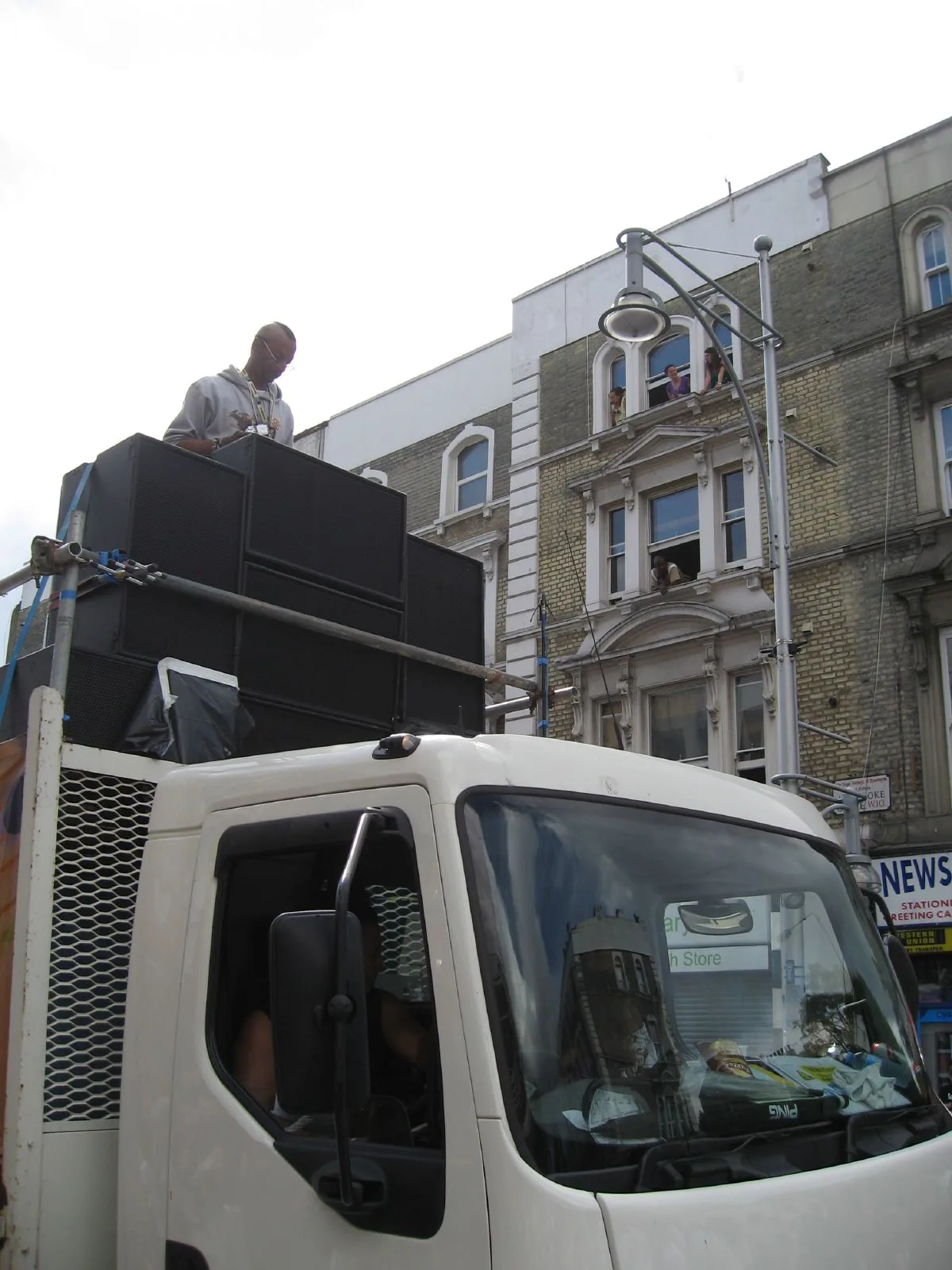
For Carnival’s 60th anniversary, more than 30 static systems are expected across the footprint on Sunday 30 and Monday 31 August. They will play from noon until 7pm, each with its own crew, selections, temperament and congregation.
Some people will move between them all day. Some will find one corner and behave as if there has never been a valid reason to leave. Both approaches have merit.
Not a DJ booth with bigger speakers
This is the first thing to get straight. A sound system is not simply decks plugged into a heroic amount of amplification.
The system has a name. A crew. A history. A particular way it should feel when the bass drops. The selector chooses the records, the mic person works the session, the engineer shapes the frequencies, and a small army has already shifted boxes, run cables and made the whole thing safe before most of us have decided what trainers we’re prepared to ruin.
At a normal festival, the PA is supposed to disappear. Engineers work where you cannot see them; speakers hang politely beside the stage; all that equipment exists to make the star audible.
At Carnival, the technology has an identity of its own. The boxes are recognisable. The crew has lineage. The way a system sounds is part of why people came. As the official Carnival archive puts it, this is both a performing and a technical art form.
The sound came over and found somewhere to live
Sound-system culture took shape in Jamaica in the 1950s: records, turntables, amplifiers and homemade speaker boxes carried into yards and public spaces, with operators competing on selections, clarity, weight and exclusives. The setup could be rough; the thinking was not. A record was no longer something you simply put on. With a selector, a microphone, effects and a crowd answering back, recorded music became a live event.
When Jamaicans came to Britain in the post-war years, the culture travelled too. British radio gave Jamaican music little room. Many clubs and pubs were unwelcoming or openly racist. So people made their own spaces: house parties, blues dances, shebeens, community halls. London Museum dates Duke Vin’s first UK sound system to 1955; he went on to play Carnival for 37 years.
We can call that entertainment, and obviously it was. But it was infrastructure as well. Somewhere to hear the new record at the proper weight. Somewhere to dress up, meet people, pass on news, test a tune, learn a trade and feel less alone in a country that was not always interested in making room.
The bass did not ask permission to belong here. It made belonging audible.
Sound systems take shape in Kingston, turning recorded music into a public, competitive and deeply physical art.
Duke Vin brings the format to Britain, according to London Museum’s account.
Leslie Palmer formally brings static systems into Notting Hill Carnival as its fifth discipline.
Over 30 systems are listed across Carnival’s 60th-anniversary weekend.
Then the boxes moved into Carnival
Carnival was not waiting for sound systems to make it Caribbean. Steelpan, calypso and masquerade were already foundational to the street event that grew in Notting Hill during the 1960s. That matters. Carnival’s arts have distinct histories; flattening them into one vague tropical mood does nobody any favours.
But by the early 1970s, organiser Leslie Palmer wanted the road to hold more of the Caribbean communities now making London home. Duke Vin and Count Suckle had already put systems out locally without official billing. In 1973, Palmer formally invited static systems into Carnival as its fifth discipline.
It changed the map.
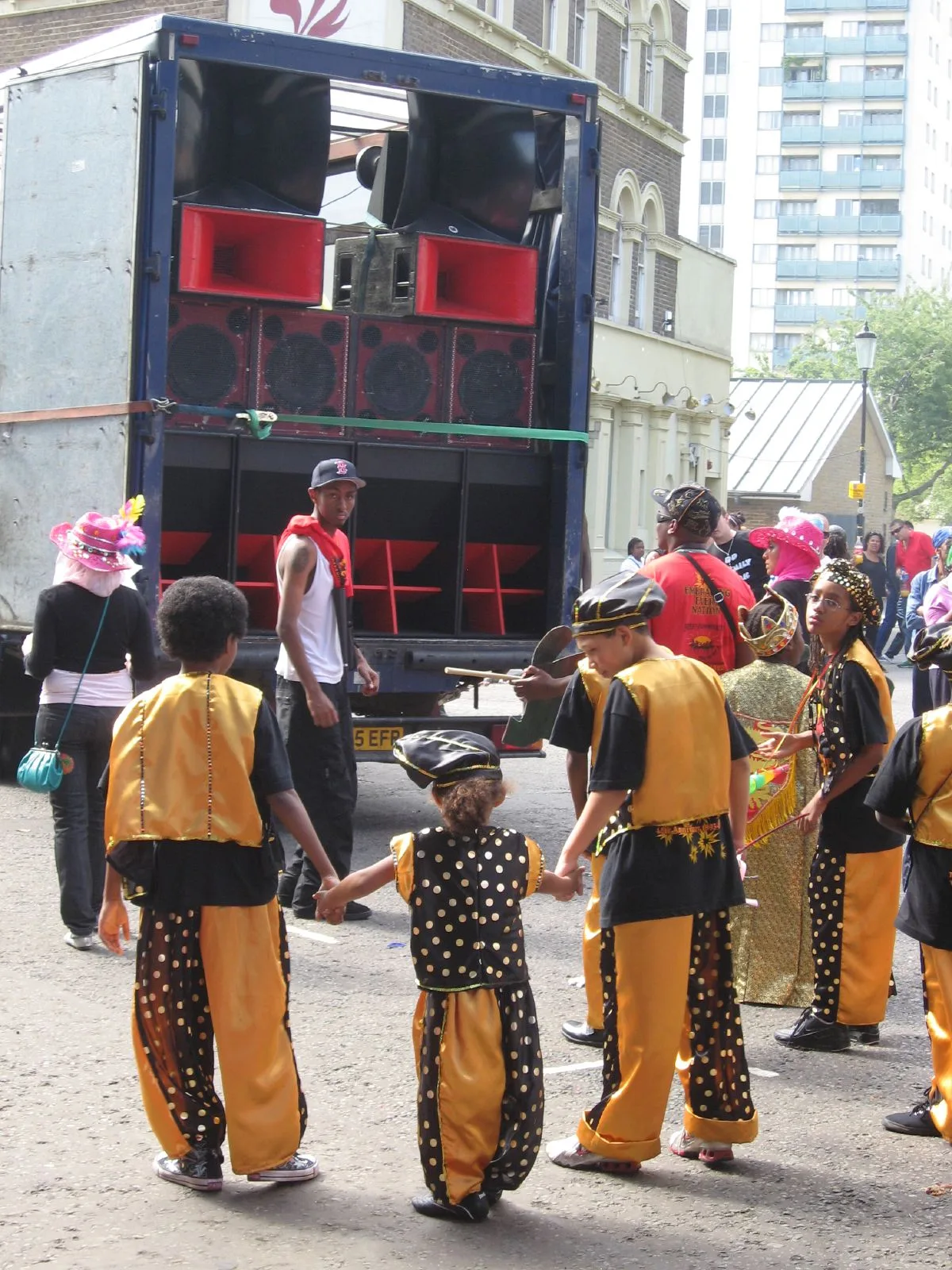
A parade moves. A static sound stays. That simple difference gave people another way to experience Carnival: claim a corner, learn its personality, come back next year. Streets became associated with sounds; sounds built communities around them. Long before location-sharing, people navigated by bass.
Four sounds. Four different rooms with no roof.
This is not a definitive ranking and never could be. It is a quick listen to how broad the word sound becomes once it is attached to people who have spent decades giving it meaning.
Channel One
Mikey Dread’s strictly vinyl, one-turntable approach is an object lesson in doing less, properly. The hand-built rig, conscious roots and heavyweight bass have held their Carnival corner since the early 1980s. Their mission is simple: break down barriers through reggae.
Aba-Shanti-I
A Carnival resident since 1993, Aba-Shanti-I works in roots and dub, with delay, reverb and effects folded into the performance. You do not so much hear the atmosphere as step inside it.
Saxon
Founded in south-east London in 1976, Saxon became a school as much as a sound. Peter King and Papa Levi helped pioneer the fast-chat microphone style; Tippa Irie, Smiley Culture and Maxi Priest are part of the wider family tree. The aftershocks run through jungle, garage and grime.
Rampage
Started at Carnival in 1992, Rampage made multi-genre scale part of its identity: R&B, hip-hop, dancehall, UK music and the possibility that somebody very famous may appear. The guests make clips. The sound keeps the crowd.
The selector is not an algorithm
Streaming has trained us to expect the next song to arrive smoothly and personally, chosen by a system that knows what we played while cooking on Tuesday.
A selector is reading a room in real time. What just landed. What did not. Whether people need pressure or release. Whether an old record is about to sound brand new because it has arrived at exactly the right minute. The decision is human, public and slightly risky. That is half the pleasure.
Then there is the dubplate: an exclusive cut or special version carrying a system’s name and reputation. The mic person giving the session shape. The engineer making sure bass has warmth as well as force. The people who lifted the boxes while the rest of us were asleep.
A proper sound is collective authorship. That may be why its influence keeps turning up wherever British music values bass, the MC and the test of a new tune against a real crowd: lovers rock, jungle, drum & bass, garage, grime, dubstep and beyond. The family tree is not a neat straight line. Musical families rarely are.
takes the controls
Inheritance
Who gets the controls next?
Sound-system history is often told through men because men got the titles, the microphone and the photograph. Women were still in the dance, doing the work and carrying the culture. Now more of them are being named where everybody can see.
Seduction City describes itself as Carnival’s first all-female-led sound system, based at Jamaica Corner. Led by Lady Banton, it builds routes for women in music and live-event technology, with Chantz Dee representing the next generation of the crew.
Linett Kamala was one of the first girl DJs to play on a Carnival sound in the early 1980s. Her LIN KAM ART work now pairs custom-built systems and forward-facing dub with Sound System Futures, training young people and women to build, operate and inherit the form.
This is not heritage preserved behind glass. Somebody still has to wire it, tune it, select for it and know what to do when the left stack starts acting funny at 1.17pm. Tradition survives because the keys change hands.
The city becomes the venue
For two days, west London stops behaving normally.
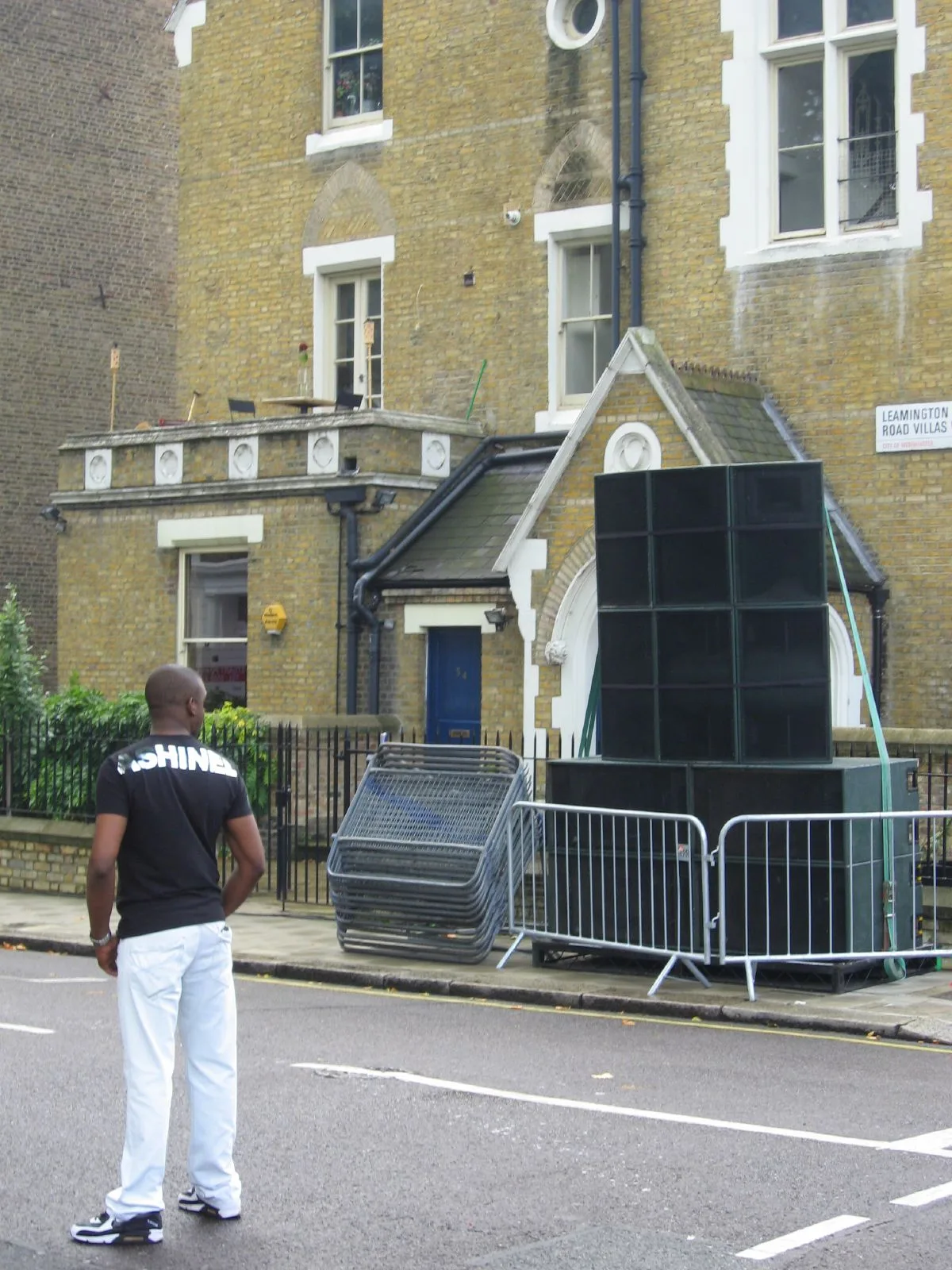
A residential street becomes a dancefloor. A garden wall becomes seating. A balcony becomes a VIP box. A junction becomes the place you have been trying to reach for 45 minutes. The buildings throw the sound back; the crowd changes how it travels; the pavement seems involved.
This is why moving the systems into tidy venues would never be a neutral swap. The street is not dead space around the music. It is part of the instrument.
So enjoy the guest if one turns up. Take your shaky little video. Send it to the friend who disappeared and will later claim they were “by the food bit”, as though that narrows anything down.
But look past the famous face. Notice the system that made the moment possible. The crew that came back. The corner people trust. The relationship built through years of records heard at the right volume.
In a music economy increasingly designed around solitary listening and prediction, sound-system culture still offers the opposite proposition:
Come outside. Stand next to strangers. Let somebody else choose the record. Decide together whether it works.
Looking for the headliner? Follow the bass.